The Offshore Dollar System is my account of today’s international monetary system. It is not a system of national currencies but a largely privatized payment system built on US dollars created outside the United States and backstopped by the Federal Reserve. This makes access to dollars a matter of geoeconomics and security.
After the end of Bretton Woods, the international monetary system was often described as a “non-system” of floating national currencies. My research shows that a privatized Offshore Dollar System took its place. It is hierarchical: the US dollar sits at the top, followed by the euro, yen, and pound, with the BRICS currencies further below. Within each currency, central bank money is scarcer than bank deposits, which are scarcer than shadow money. Most dollars used internationally are created by banks and shadow banks outside the United States, beyond the reach of US law.
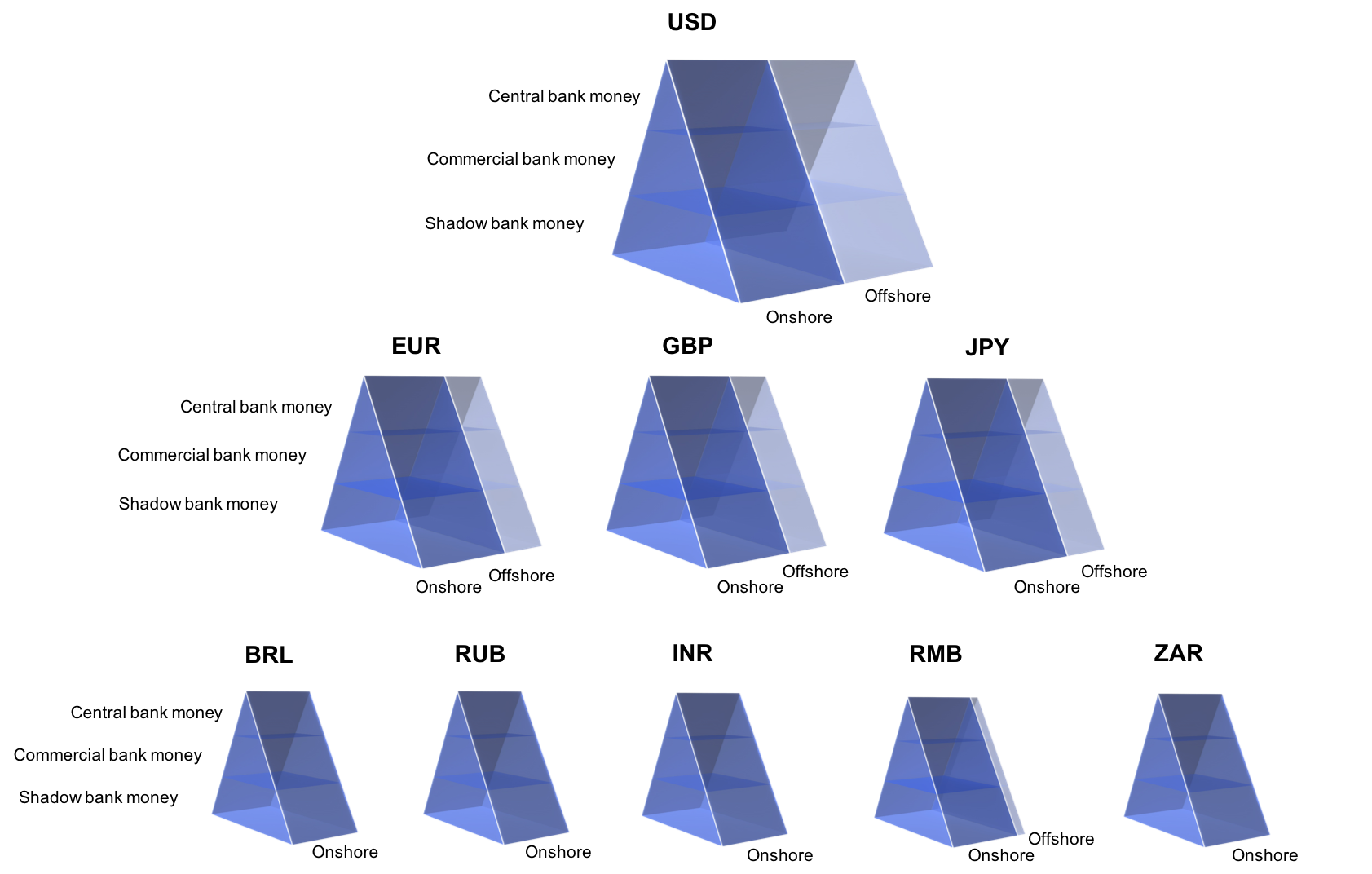
The international monetary system as a hierarchical structure based on offshore credit money creation. Figure by Steffen Murau (all rights reserved).
The system emerged in three steps. In the 1950s and 1960s, the Eurodollar market extended dollar deposit creation to London and other financial centres, as New York banks escaped domestic regulation. From the 1970s, shadow banking added offshore shadow money, such as money market fund shares and foreign exchange swaps. In the 2007–9 crisis, the Federal Reserve’s swap lines with other central banks created offshore central bank money; some became permanent, so the offshore dollar realm now mirrors the US system itself. With co-authors, I have studied these steps, the hierarchy of swap lines and the FIMA repo facility, and Special Drawing Rights as an alternative. With Herman Mark Schwartz, I have developed this into the Global Credit View, presented in two special issues.
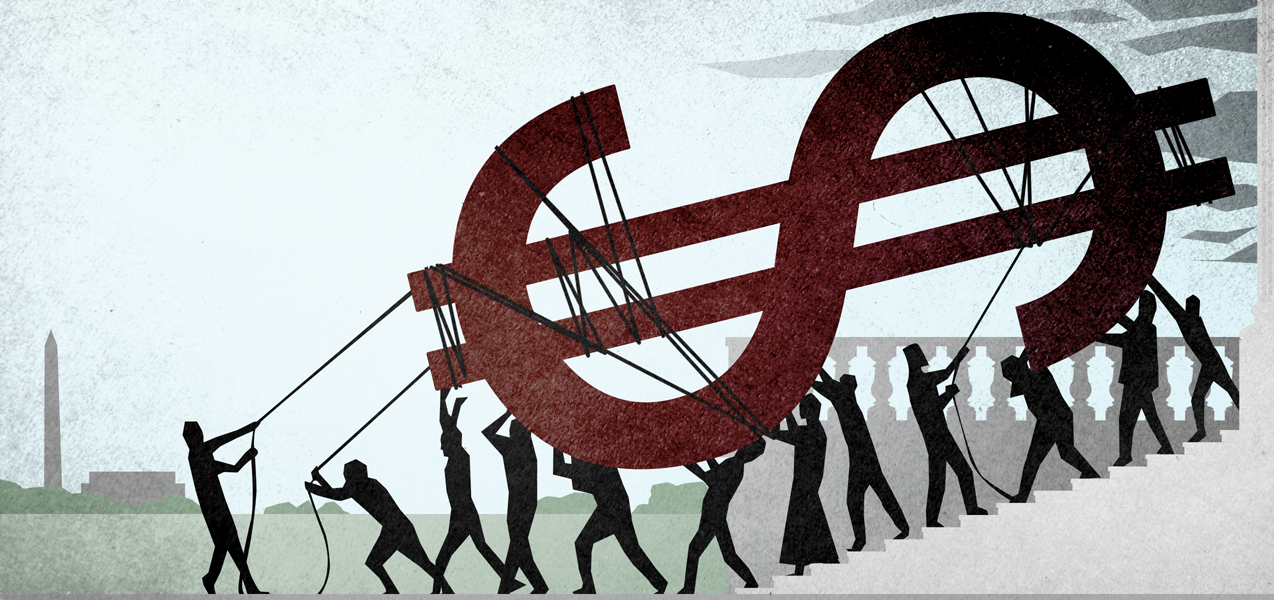
Erecting the Eurodollar system (symbolically). Image: CC BY-NC-SA Jared Rodriguez/Truthout via flickr.com
The Offshore Dollar System is now at the centre of geoeconomic debates. Sanctions, frozen central bank reserves, and the selective extension of swap lines have turned dollar infrastructure into an instrument of power. My current work maps who creates, holds, and backstops dollar claims, how the BRICS and Europe are embedded in the system, and what room for maneuver states have.
Key publications
- ‘The Evolution of the Offshore US-Dollar System. Past, Present and Four Possible Futures’ (with Joe Rini and Armin Haas), Journal of Institutional Economics, 2020.
- ‘Financial Globalization as Positive Integration. Monetary Technocrats and the Eurodollar Market in the 1970s’ (with Benjamin Braun and Arie Krampf), Review of International Political Economy, 2021.
- ‘International Monetary Hierarchy through Emergency US-Dollar Liquidity. A Key Currency Approach’ (with Fabian Pape and Tobias Pforr), Competition and Change, 2023.
- ‘Rethinking Monetary Sovereignty. The Global Credit Money System and the State’ (with Jens van ’t Klooster), Perspectives on Politics, 2023.
- ‘Voluntary Channeling and the Limitations to Financial Redistribution in the Special Drawing Rights System’ (with Tobias Pforr and Fabian Pape), Journal of Globalization and Development, 2026.
- ‘Decoding Dollar Dominance. The Global Credit View on the Offshore Dollar System’ (with Herman Mark Schwartz), Economy and Society, forthcoming.
All publications are listed under Publications.